Literarisches & Journalistisches
Global Media Law: Regulierung von Plattformen gefordert
10. November 2025Bei der Global Media Law Konferenz in Berlin diskutierten Vertreterinnen und Vertreter aus Politik, Wirtschaft, Wissenschaft und Gesellschaft über die Verantwortung der Tech-Firmen.

Wirtschaftswissenschaftler von FehrAdvice & Partners belegen mit verhaltensökonomischem Experiment: 73 Prozent der Nutzer bevorzugen die Suchmaschine Google mit journalistischen Inhalten. Weitere Erkenntnisse: journalistische Medien tragen besonders zu Aktualität, Vertrauen sowie Vollständigkeit von Suchergebnissen bei. Im Schnitt erhöhen journalistische Medien den Wert von Google um 24 Prozent. Das Beratungsunternehmen, das von Professor Ernst Fehr, einem weltweit führenden Verhaltensökonomen gegründet wurde, hat vergleichbare Studien bereits in der Schweiz, Großbritannien und Polen durchgeführt.

SEE.EU is a concrete and mature new concept for the European media landscape. Our vision: a shared digital space where trustworthy news from licensed public broadcasters across Europe is accessible to everyone – multilingual, transparent, and aligned to European values and data laws. Making quality journalism available to all Europeans – in their own language, from verified sources, across borders.
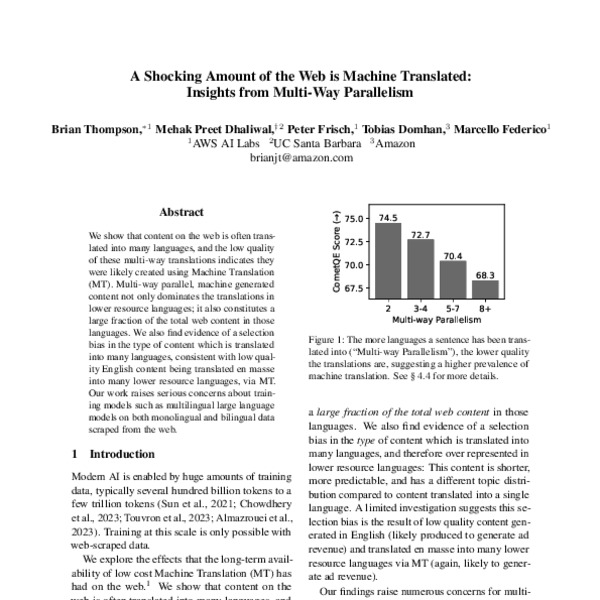
A Shocking Amount of the Web is Machine Translated: Insights from Multi-Way Parallelism
05. Januar, 2024We show that content on the web is often translated into many languages, and the low quality of these multi-way translations indicates they were likely created using Machine Translation (MT). Multi-way parallel, machine generated content not only dominates the translations in lower resource languages; it also constitutes a large fraction of the total web content in those languages. We also find evidence of a selection bias in the type of content which is translated into many languages, consistent with low quality English content being translated en masse into many lower resource languages, via MT. Our work raises serious concerns about training models such as multilingual large language models on both monolingual and bilingual data scraped from the web.

Demokratie statt Algokratie
02. Januar, 2024Man muss es so drastisch formulieren: Die Demokratie ist bedroht. Heute haben einige wenige amerikanische Big-Tech-Unternehmen Wirtschaftszweige erobert, durch die sie die vierte Macht im Staat zerstören können: den privat finanzierten und auch den öffentlich-rechtlichen Journalismus. War es zunächst "nur" die Kakophonie der sozialen Netzwerke so wird nun durch generative KI wie ChatGPT des amerikanischen Unternehmens OpenAI, das von Microsoft beherrscht wird, die Produktion von Texten und Bildern zunehmend von Journalisten an algorithmische Systeme ausgelagert. Der KI müssen klare rote Linien gesetzt werden, wie das der AI-Act der EU-Kommission vorbereitet.
The Internet has changed the past. Social media, Wikipedia, mobile networks, and the viral and visual nature of the Web have inundated the public sphere with historical information and misinformation, changing what we know about our history and History as a discipline. This is the first book to chronicle how and why it matters. Why does History matter at all? What role do history and the past play in our democracy? Our economy? Our understanding of ourselves? How do questions of history intersect with today’s most pressing debates about technology; the role of the media; journalism; tribalism; education; identity politics; the future of government, civilization, and the planet? At the start of a new decade, in the midst of growing political division around the world, this information is critical to an engaged citizenry. As we collectively grapple with the effects of technology and its capacity to destabilize our societies, scholars, educators and the general public should be aware of how the Web and social media shape what we know about ourselves - and crucially, about our past.
1962 erschien Strukturwandel der Öffentlichkeit, Jürgen Habermas' erstes Buch. In sozialhistorischer und begriffsgeschichtlicher Perspektive profiliert er darin einen Begriff von Öffentlichkeit, der dieser einen Platz zwischen Zivilgesellschaft und politischem System zuweist. Der Strukturwandel reihte sich alsbald ein unter die großen Klassiker der Soziologie des 20. Jahrhunderts und hat eine breite Forschung in den Geschichts- und Sozialwissenschaften angeregt. Und auch Habermas selbst hat sich in späteren Arbeiten immer wieder mit der Rolle der Öffentlichkeit für die Bestandssicherung des demokratischen Gemeinwesens beschäftigt. Angesichts einer durch die Digitalisierung veränderten Medienstruktur und der Krise der Demokratie kehrt er nun erneut zu diesem Thema zurück.
This report presents the first published analysis of the Europol Innovation Lab’s Observatory function, focusing on deepfakes, the technology behind them and their potential impact on law enforcement and EU citizens. Deepfake technology uses Artificial Intelligence to audio and audio-visual content. Deepfake technology can produce content that convincingly shows people saying or doing things they never did, or create personas that never existed in the first place. To date, the Europol Innovation Lab has organised three strategic foresight activities with EU Member State law enforcement agencies and other experts. During strategic foresight activities conducted by the Europol Innovation Lab, over 80 law enforcement experts identified and analysed the trends and technologies they believed would impact their work until 2030. These sessions showed that one of the most worrying technological trends is the evolution and detection of deepfakes, as well as the need to address disinformation more generally. The findings in this report are the result of extensive desk research supported by research provided by partner organisations, expert consultation, and the strategic foresight activities. Those workshops provided the initial input for this report. Furthermore, the findings are the result of extensive desk research supported by research provided by partner organisations, expert consultation and the strategic foresight activities conducted by the Europol Innovation Lab. Strategic foresight and scenario methods offer a way to understand and prepare for the potential impact of new technologies on law enforcement. The Europol Innovation Lab’s Observatory function monitors technological developments that are relevant for law enforcement and reports on the risks, threats and opportunities of these emerging technologies.
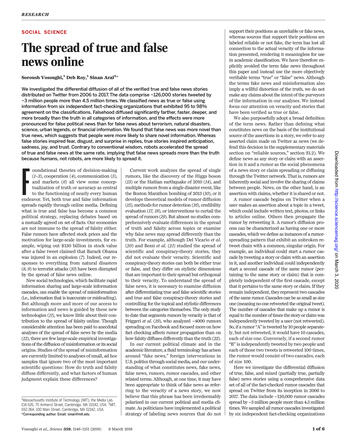
The spread of true and false news online
09. Mai, 2018There is worldwide concern over false news and the possibility that it can influence political, economic, and social well-being. To understand how false news spreads, Vosoughi et al. used a data set of rumor cascades on Twitter from 2006 to 2017. About 126,000 rumors were spread by ∼3 million people. False news reached more people than the truth; the top 1% of false news cascades diffused to between 1000 and 100,000 people, whereas the truth rarely diffused to more than 1000 people. Falsehood also diffused faster than the truth. The degree of novelty and the emotional reactions of recipients may be responsible for the differences observed.

100 Voices
2010Drawing on 100 never-before-published interviews, Scott McConnell presents a unique portrait of a larger-than-life literary giant and a fascinating individual, Ayn Rand. Focusing on the private Rand, McConnell talked to the author's family, friends, fans, and associates, as well as Hollywood stars, university professors, fiction writers, and many more. Arranged in chronological order, these interviews cover a broad range of years, contexts, relationships, and observations on one of the most influential- and controversial-figures of the twentieth century. From Ayn Rand's youngest sister to the woman who inspired the character of Peter Keating in The Fountainhead, the subjects interviewed offer fresh, sometimes surprisingly candid, affectionate, and intriguing insights into a complex and remarkable writer, philosopher, and human being.

Die Theorie des kommunikativen Handelns dient der Klärung der Grundlagen... | Buch von Jürgen Habermas versandkostenfrei & direkt vom Verlag kaufen

"Aus dem Wörterbuch des Unmenschen" ist ein Buch von Dolf Sternberger, Gerhard Storz und Wilhelm Emanuel Süskind, das erstmals 1957 veröffentlicht wurde. Es beschäftigt sich kritisch mit der Sprache des Nationalsozialismus und analysiert die Begriffe und Redewendungen, die während dieser Zeit in Deutschland geprägt wurden. Die Autoren beleuchten, wie Sprache als Mittel zur Manipulation und Ideologievermittlung genutzt wurde, indem sie spezifische Wörter und deren Bedeutungsveränderung untersuchen. Das Buch dient als Warnung vor der Macht der Sprache und zeigt auf, wie wichtig es ist, sich der Worte bewusst zu sein, die man verwendet. Durch seine präzise Analyse trägt es dazu bei, die Mechanismen totalitärer Sprachverwendung zu verstehen und sensibilisiert für einen verantwortungsvollen Umgang mit Sprache.

Widely regarded as one of the most influential philosophical works of the twentieth century, Ludwig Wittgenstein's Tractatus Logico-Philosophicus is a succinct yet wide-ranging exploration of language and logic, science and mysticism, which has inspired generations of thinkers, artists and poets. In a series of short, bold statements, Wittgenstein seeks to define the limits of language, its relation to logic, its power and its inherent failings. Originally published in the early 1920s, it is the only book-length work the renowned philosopher published in his lifetime. In this thrilling new translation, Alexander Booth displays an extraordinary sensitivity to the subtle influence on Wittgenstein's gem-like prose--at once specialist and, often, remarkably plain-spoken--considering his background in mechanical engineering, while highlighting the underlying poetry of this seminal text.