Literarisches & Journalistisches
Global Media Law: Regulierung von Plattformen gefordert
10. November 2025Bei der Global Media Law Konferenz in Berlin diskutierten Vertreterinnen und Vertreter aus Politik, Wirtschaft, Wissenschaft und Gesellschaft über die Verantwortung der Tech-Firmen.

Wirtschaftswissenschaftler von FehrAdvice & Partners belegen mit verhaltensökonomischem Experiment: 73 Prozent der Nutzer bevorzugen die Suchmaschine Google mit journalistischen Inhalten. Weitere Erkenntnisse: journalistische Medien tragen besonders zu Aktualität, Vertrauen sowie Vollständigkeit von Suchergebnissen bei. Im Schnitt erhöhen journalistische Medien den Wert von Google um 24 Prozent. Das Beratungsunternehmen, das von Professor Ernst Fehr, einem weltweit führenden Verhaltensökonomen gegründet wurde, hat vergleichbare Studien bereits in der Schweiz, Großbritannien und Polen durchgeführt.

SEE.EU is a concrete and mature new concept for the European media landscape. Our vision: a shared digital space where trustworthy news from licensed public broadcasters across Europe is accessible to everyone – multilingual, transparent, and aligned to European values and data laws. Making quality journalism available to all Europeans – in their own language, from verified sources, across borders.
The Internet has changed the past. Social media, Wikipedia, mobile networks, and the viral and visual nature of the Web have inundated the public sphere with historical information and misinformation, changing what we know about our history and History as a discipline. This is the first book to chronicle how and why it matters. Why does History matter at all? What role do history and the past play in our democracy? Our economy? Our understanding of ourselves? How do questions of history intersect with today’s most pressing debates about technology; the role of the media; journalism; tribalism; education; identity politics; the future of government, civilization, and the planet? At the start of a new decade, in the midst of growing political division around the world, this information is critical to an engaged citizenry. As we collectively grapple with the effects of technology and its capacity to destabilize our societies, scholars, educators and the general public should be aware of how the Web and social media shape what we know about ourselves - and crucially, about our past.
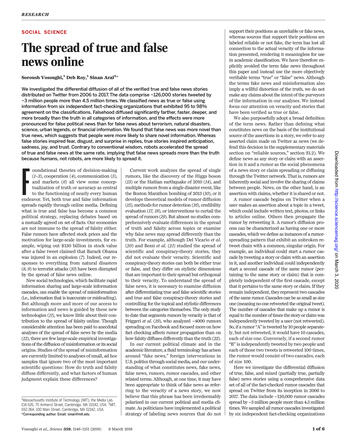
The spread of true and false news online
09. Mai, 2018There is worldwide concern over false news and the possibility that it can influence political, economic, and social well-being. To understand how false news spreads, Vosoughi et al. used a data set of rumor cascades on Twitter from 2006 to 2017. About 126,000 rumors were spread by ∼3 million people. False news reached more people than the truth; the top 1% of false news cascades diffused to between 1000 and 100,000 people, whereas the truth rarely diffused to more than 1000 people. Falsehood also diffused faster than the truth. The degree of novelty and the emotional reactions of recipients may be responsible for the differences observed.